Introduction: From Vision to Execution
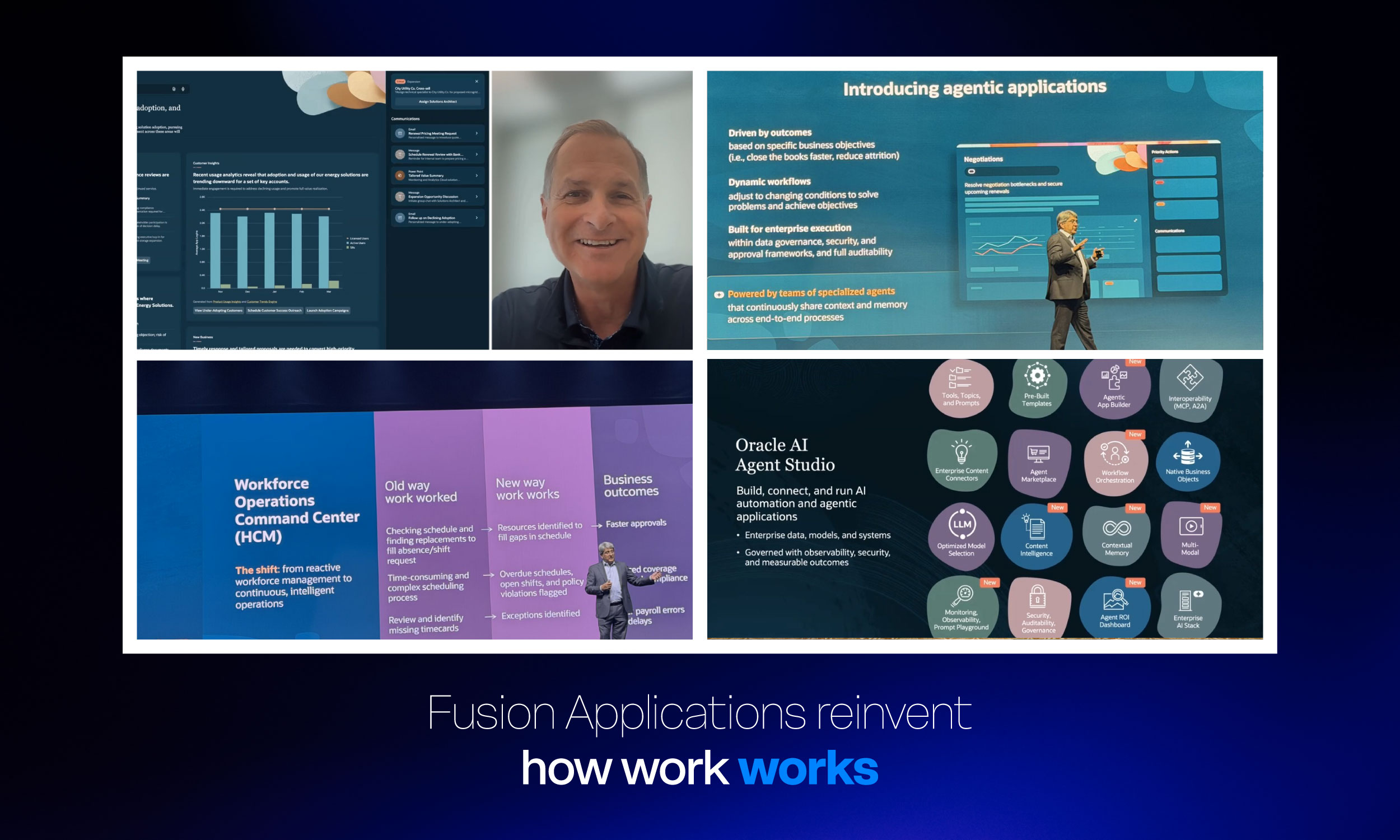
At the Oracle AI World Tour London 2026, one message stood out clearly: AI in the enterprise is no longer experimental — it is now operational at scale. The keynote sessions led by Oracle leadership, including Mike Sicilia, Steve Miranda, and Juan Loaiza, highlighted a fundamental shift — systems are no longer just recording transactions, data is no longer waiting to be analysed, AI is no longer an add-on, and enterprise applications are being redesigned to drive decisions and actions in real time. This shift is most visible in Fusion Agentic Applications — and what they represent is far more than a feature release.
The Reality Today: Where Work Slows Down
Despite modern systems, most organisations still operate like this — data exists across systems, insights require effort, decisions take time, and actions are delayed. Users are still expected to navigate, interpret, coordinate, and decide. And this is exactly where business velocity is lost.
The Shift: Systems That Drive Work
Fusion Agentic Applications change this equation. What I observed is a move from systems that support work to systems that actively move work forward — understanding context, reasoning across processes, recommending next-best actions, explaining decisions, and executing tasks where appropriate. Instead of asking “What should I do next?”, users are guided with: “Here’s what matters. Here’s what to do. Here’s why.”
A New Model: Digital Teams Within Applications
Business problems are not solved in isolation. They require collaboration, shared context, and continuous decision-making. Agentic Applications bring this model into the system itself, operating as digital teams of intelligent agents — each with a defined role, working towards a clear objective, and sharing context with other agents — together analysing situations, prioritising actions, and driving outcomes. This is not traditional automation. It is coordinated, context-aware execution.
How This Will Reshape Work
This shift will fundamentally change how work is done across enterprises.
1. From Navigation to Guidance — Users will no longer spend time navigating multiple systems. Work will be surfaced proactively and priorities will be clearly defined.
2. From Analysis to Decision Acceleration — Instead of analysing data manually, systems will interpret context, provide recommendations, and reduce decision time significantly.
3. From Reactive to Proactive Operations — Today, actions are often triggered after issues arise. With agentic systems, risks are identified early, actions are suggested proactively, and decisions happen before impact.
4. From Fragmented Workflows to Continuous Flow — The biggest transformation is this: data → insight → decision → action becomes a continuous loop. This eliminates delays between steps and drives real business velocity.
5. From Execution to Strategic Focus — As systems take on operational responsibility, people move away from repetitive execution towards higher-value strategic thinking.
Where It Becomes Real: Workforce Scheduling in HCM
One example that clearly illustrates this shift is workforce scheduling — not just approvals, but a combination of skills, coverage, policies, constraints, and business priorities. Traditionally, this meant multiple systems, manual validation, and time-consuming decisions. With Agentic Applications, the system understands the full operational context, identifies gaps and risks, recommends optimal actions, and executes where appropriate — auto-approving non-conflicting absences, flagging and rejecting requests impacting operations, and suggesting alternative solutions. And importantly, it explains decisions — building trust and enabling governance.
The Enabler: Oracle AI Agent Studio
A major step forward is the introduction of Oracle AI Agent Studio. It enables organisations to define agents using natural language, assemble multi-agent workflows, customise based on their business processes, and deploy rapidly. This means enterprises are no longer limited to predefined systems — they can design intelligent systems aligned to their reality.
What This Means for Enterprises
This is not just a technology upgrade. It is a shift in how decisions are made, how work flows across functions, and how quickly organisations can respond. The impact is tangible — faster decision-making, reduced operational overhead, improved consistency, and better employee and customer experience.
How Kovaion Is Taking This Forward
At Kovaion, we see this as a pivotal moment. Our focus is clear.
1. From Implementation to Intelligent Design — We are evolving from system implementers to designers of decision-driven systems.
2. Building Agentic Use Cases on Oracle Stack
3. Bridging Business and AI — The biggest gap today is not technology — it is translation. We aim to translate business problems into agentic solutions, ensure AI delivers measurable outcomes, and align innovation with real enterprise needs.
4. Enabling Customers to Adopt with Confidence — Adoption is key. We are focusing on practical use cases, governance and explainability, and phased implementation strategies. Because success is not about building AI — it is about making it work in real environments.
Final Reflection
The real challenge in organisations today is not the lack of systems. It is the gap between data → insight → decision → action. This is where time is lost. This is where value is delayed. What I saw at the Oracle AI World Tour London 2026 is this gap being compressed into a continuous, intelligent flow. And that… is where true enterprise transformation begins.
What’s Next
This is just the beginning of a broader shift. In the upcoming newsletter, I will be sharing deeper technical insights on AI Data Platform, Private Agent Factory, Enterprise AI architecture, and practical adoption strategies. Stay tuned to our upcoming editions for more technical updates and insights.