HCM Cloud -Oracle Integration Agents
Introduction:
What is Connectivity Agent & Why do you need it?
- Connectivity Agents enable integration between on-premises applications and Oracle Integration Cloud (OIC) Service.
- They are essential for OIC to communicate and exchange data with on-premises systems such as databases and enterprise applications like Oracle E-Business Suite.
Agent Framework
The Connectivity Agents Framework in Oracle Integration (formerly known as Oracle Integration Cloud or OIC) is a component that facilitates secure communication between your on-premises applications and Oracle Integration Cloud. This framework enables you to connect your cloud-based integration flows with resources that reside within your corporate network or private cloud.
Here’s an overview of how the Connectivity Agents Framework works:
- Agent Installation: You start by installing a lightweight agent within your corporate network. This agent acts as a bridge between your on-premises applications and Oracle Integration Cloud.
- Secure Communication: The agent establishes a secure outbound connection to Oracle Integration Cloud over HTTPS. This connection ensures that data transmitted between your on-premises systems and the cloud integration platform remains encrypted and secure.
- Outbound Communication: When you create integration flows within Oracle Integration Cloud, you can configure them to leverage the connectivity agent for outbound communication. This allows your cloud-based integration to interact with on-premises resources such as databases, applications, and services.
- Inbound Communication: The connectivity agent also supports inbound communication, enabling on-premises systems to initiate requests to Oracle Integration Cloud. This capability is useful for scenarios where your cloud-based integration need to respond to events or triggers from your internal systems.
- Proxy Support: The agent can be configured to work with corporate proxies, allowing it to communicate with Oracle Integration Cloud even in environments with strict network policies.
- High Availability: To ensure reliability, you can deploy multiple connectivity agents in a high-availability configuration. This setup provides redundancy and fault tolerance, minimizing the risk of downtime for your integration processes.
Steps for Using Connectivity Agents in OIC
Create Connectivity Agent Group in OIC.
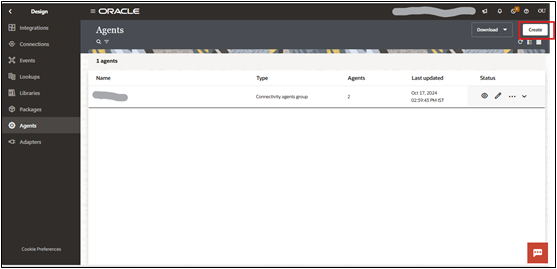
Fig:1
- Click the create button to create the agents
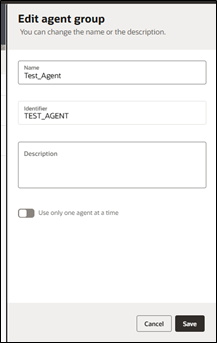
Fig:2
- Enter the Name of the agent and auto-populate the Identifier, click save
- Download and run the on-premises connectivity agent installer from OIC to the Source/Target System that OIC is connecting.
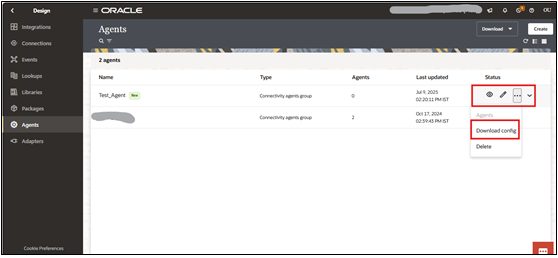
Fig 3
- Test_Agent will be created, and the status below has three icons
- Eye icon to view the Agent
- Edit Icon to edit the Name
- Click the three-dot action below, Download Configure, and click
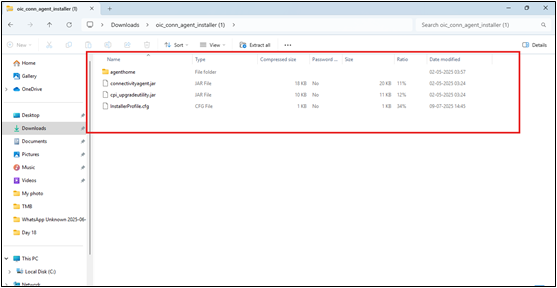
Fig:4
- make its zip file and configure with server, and execute the agent installer
- Design the integration that uses this Adapter connection
- Activate the integration.
Agents in HA:
- High Availability (HA) in Oracle Integration 3 (OIC 3) ensures that integration services are continuously available and resilient to failures. Agents in OIC 3 play a crucial role in achieving HA by managing the connectivity between Oracle Integration instances and on-premises applications or systems. These agents are lightweight software components installed on-premises to facilitate secure communication and data exchange with cloud services.
- For high availability, multiple agents can be deployed to provide redundancy. If one agent fails or becomes unavailable, another agent can take over the tasks, ensuring no disruption in the integration process.
- Agents are designed to balance loads and distribute tasks efficiently, minimizing downtime and maintaining seamless operations.
Conclusion
Connectivity agents in Oracle Integration 3 are essential for integrating on-premises and cloud applications. They ensure secure and efficient data flow between Oracle Integration Cloud and on-premises systems, allowing organizations to leverage both environments effectively. These agents enhance the platform’s flexibility, enabling robust hybrid integration solutions.
Ready to Simplify Your Oracle HCM Cloud Integrations?
Managing integrations between Oracle HCM Cloud and your enterprise applications doesn’t have to be complex. With Oracle Integration Agents, organizations can securely connect cloud and on-premises systems, automate data exchange, reduce manual effort, and improve business efficiency. Whether you’re integrating payroll, ERP, third-party applications, or legacy systems, the right integration strategy can help you achieve seamless connectivity and real-time data synchronization.
At Kovaion, our Oracle experts help organizations design, implement, and optimize Oracle HCM Cloud integrations tailored to their unique business requirements. From deployment and configuration to ongoing support and performance optimization, we ensure your integration ecosystem remains secure, scalable, and future-ready. Contact us today to discover how Oracle Integration Agents can accelerate your digital transformation journey.