Oracle 26B: HCM Data Loader (HDL) Enhancement for Salary Basis
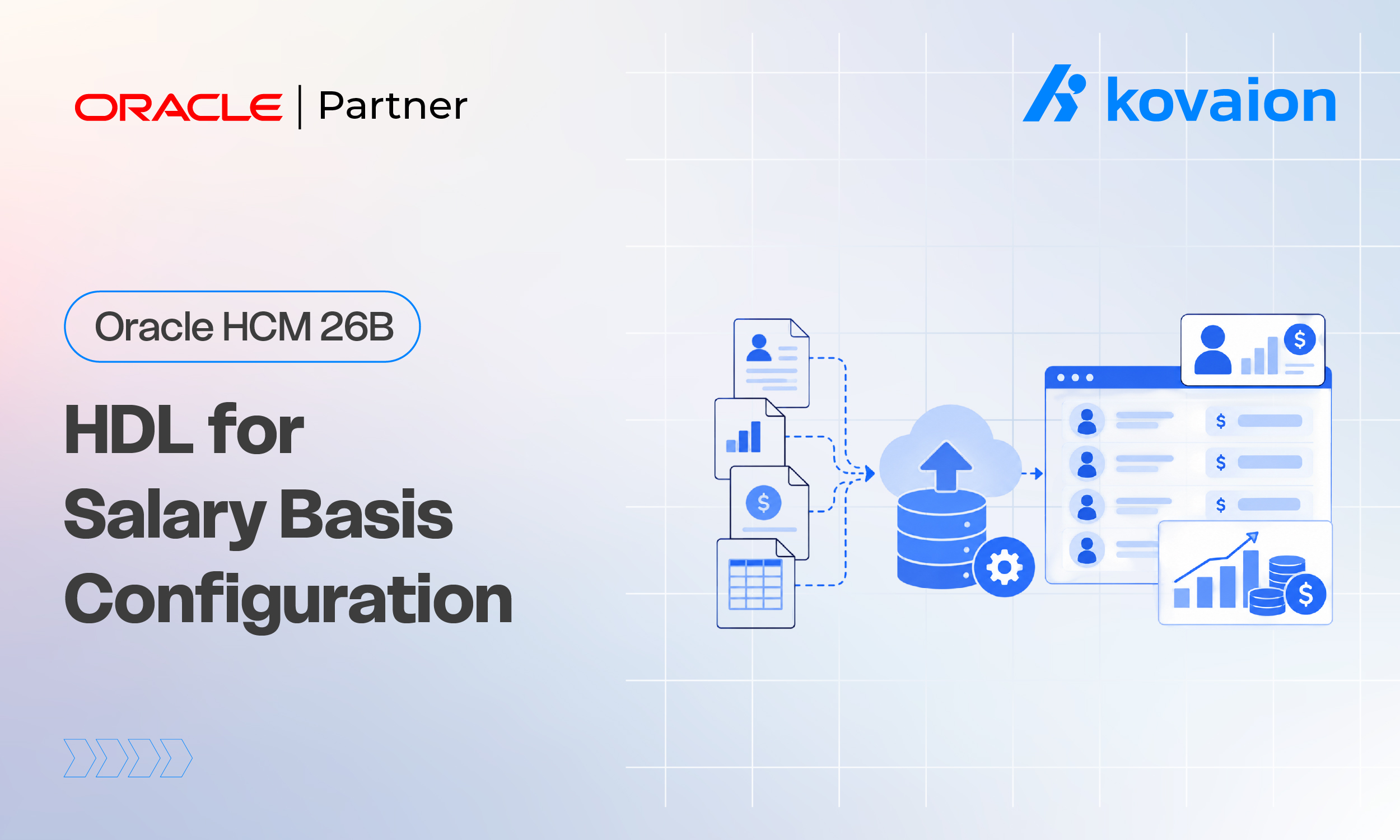
Oracle 26B introduces an enhancement to HCM Data Loader (HDL) that simplifies salary basis configuration for compensation teams. Organizations can now use HDL to load salary basis records with straightforward component calculation methods, reducing the need for repetitive manual configuration across compensation interfaces.
This update helps streamline compensation administration by improving data consistency, reducing manual effort, and supporting more efficient salary configuration workflows. The loaded salary basis components can also be used across relevant compensation processes, including offer creation and manager-initiated compensation adjustments.
In this blog, we explore the Oracle 26B HCM Data Loader enhancement, how it supports salary basis configuration, key business and technical benefits, and the implementation considerations organizations should review before using it in their Oracle Fusion Cloud HCM environment.
Understanding the Challenge in Compensation Administration
Compensation management in large enterprises involves coordinating multiple system components, data sources, and organizational hierarchies. Compensation specialists frequently encounter operational barriers when managing salary structures, particularly when dealing with straightforward, non-complex compensation formulas.
Traditionally, configuring salary basis records with uncomplicated calculation logic required navigating multiple user interfaces, manually entering identical information across disconnected screens, and maintaining separate data entry processes. This fragmented approach introduced multiple pain points:
- Time-intensive manual processes consuming significant compensation team resources
- Increased probability of data inconsistencies and entry errors
- Difficulty maintaining audit trails across compensation modules
- Limited ability to scale compensation configurations as organizations expand
Oracle 26B Resolution: Enhanced HCM Data Loader Integration
Oracle has addressed this operational challenge by extending HCM Data Loader (HDL) capabilities to directly manage salary basis records employing uncomplicated component calculation methodologies. This enhancement simplifies how compensation administrators approach configuration and deployment.
Direct Data Integration Framework
Compensation professionals can now use HDL to upload pre-formatted salary basis configuration files containing straightforward component definitions. The system processes these files, validates configuration parameters, and deploys salary components directly into the compensation infrastructure without intermediate manual steps.
Expanded Functionality in Self-Service Environments
Pre-configured salary components loaded through HDL become accessible within Redwood-based offer creation interfaces. This capability enables recruiters to include compensation details in employment offers with greater accuracy and consistency, while maintaining visibility into grade-based progression frameworks.
Enhanced Manager Self-Service Capabilities
Manager-initiated compensation adjustments now incorporate enhanced functionality supporting straightforward salary components. These improvements facilitate direct salary modifications while preserving compensation history and supporting organizational compensation policies.
Key Advantages of This Enhancement
Operational Efficiency Gains
- Consolidate compensation configuration activities into a unified data loading process
- Reduce redundant data entry across multiple compensation administration screens
- Accelerate deployment timelines for compensation structure modifications
Data Governance and Consistency
- Establish a single authoritative source for salary basis definitions
- Strengthen data quality by minimizing manual transcription requirements
- Generate comprehensive audit documentation for compliance verification
Enhanced Compliance and Risk Management
- Maintain detailed compensation configuration history for regulatory compliance
- Reduce compensation discrepancies that could impact payroll accuracy
- Improve transparency between offer representations and payroll execution
Implementation Considerations
Data Preparation Requirements
Successful HDL implementation requires properly structured data files. Compensation teams must ensure that salary basis records and component definitions conform to HCM Data Loader format specifications. Verification against official documentation and preliminary validation testing can help prevent deployment complications.
Component Definition Strategy
Organizations should establish consistent naming conventions and definitions for salary components before initiating HDL loading. Changing component classifications after implementation can create historical data reconciliation challenges and complicate trend analysis.
Grade Structure Alignment
When utilizing grade-based progression frameworks, ensure organizational grade hierarchies are synchronized with component definitions. The system references grade structures during offer generation and compensation management activities.
Offer Page Customization
While the feature activates automatically, compensation administrators may customize Redwood offer interface components through VB Studio configuration to reflect organizational preferences and display specifications.
Access Control Configuration
Establish appropriate role-based access permissions for compensation professionals and manager self-service users. Verify that security configurations align with organizational data governance policies.
Testing Protocol
Before deploying HDL configuration to production systems, conduct comprehensive testing with representative salary basis subsets. Validate data loading accuracy, component availability across modules, and integration with offer generation processes.
Business and Technical Benefits
Compensation Team Benefits
- Accelerated configuration processes enabling faster deployment of compensation structure changes
- Reduced administrative overhead through elimination of manual data re-entry
- Improved information accuracy, reducing payroll discrepancies and reconciliation effort
- Enhanced coordination between compensation planning and payroll execution
Recruitment and Manager Benefits
- Ability to generate accurate and competitive compensation offers more efficiently
- Clear visibility into compensation structures and advancement opportunities
- Streamlined manager compensation adjustment workflows
Financial and Audit Benefits
- Comprehensive compensation configuration documentation supporting audit requirements
- Enhanced reconciliation capabilities between employment offers and actual compensation
- Reduced operational expenses through efficiency improvements
Summary
Oracle 26B’s extension of HCM Data Loader (HDL) functionality to accommodate straightforward salary component configurations provides a more streamlined approach to compensation administration. By consolidating configuration activities into a unified data loading framework, organizations can reduce manual effort while maintaining data governance standards.
The ability to leverage loaded components across offer generation, manager self-service, and compensation history tracking supports more consistent compensation workflows. For compensation teams managing complex organizational structures, this enhancement can help improve configuration efficiency, data consistency, and compensation administration processes.
Transform Your HR Processes with Oracle HCM Cloud Services
Managing compensation data efficiently is an important part of building streamlined and connected HR processes. Kovaion’s Oracle HCM Cloud Services help organizations optimize HCM configurations, automate data management, and improve compensation and workforce management processes across Oracle Cloud HCM.
From HCM Data Loader (HDL) and compensation configuration to broader Oracle Cloud HCM implementation, integration, and optimization, our team helps organizations build scalable and well-governed HCM environments aligned with their business requirements.
Looking to optimize your Oracle HCM Cloud environment? Connect with Kovaion to explore our Oracle HCM Cloud Services and discover how we can support your HR transformation initiatives.
FAQs
Oracle 26B extends HCM Data Loader (HDL) capabilities to support the configuration of salary basis records with straightforward component calculation methods, reducing the need for repetitive manual configuration.
HDL allows compensation professionals to upload structured salary basis configuration data, enabling the system to process and deploy the relevant salary components through a data-loading process.
Yes. Salary components configured through HDL can be made available within relevant Redwood-based offer creation processes, helping recruiters include compensation information consistently in employment offers.
The enhancement supports salary components used in relevant manager self-service compensation workflows, allowing managers to work with configured salary information while maintaining compensation history.
Organizations should prepare correctly structured HDL files, establish consistent component definitions, align salary components with grade structures, verify security roles, and conduct testing before moving configurations to production.
Yes. Organizations can use available configuration capabilities, including Visual Builder Studio (VB Studio), to customize relevant Redwood offer interface components according to their business and display requirements.
Key benefits include reduced manual data entry, more consistent salary basis configuration, streamlined deployment processes, improved data governance, and better alignment between compensation configuration and downstream HR processes.