Oracle APEX Development Services: What Every Business Should Know
Enterprise applications have become a key driver of business agility, operational efficiency, and digital transformation. As organizations continue to evolve, they need application development solutions that are fast, secure, scalable, and aligned with changing business needs. Oracle APEX Development Services help businesses rapidly build modern enterprise applications while making the most of their existing Oracle technology investments.
From employee self-service portals and approval workflows to ERP extensions, reporting dashboards, and customer portals, Oracle APEX enables organizations to develop custom applications that integrate seamlessly with Oracle Database, Oracle ERP, Oracle HCM, and other enterprise systems. Its low-code approach accelerates application delivery without compromising enterprise-grade security, scalability, or performance.
Whether you’re planning to modernize legacy applications, automate business processes, or develop new enterprise solutions, Oracle APEX provides a flexible platform for innovation. In this article, we’ll explore what Oracle APEX Development Services include, the business value they deliver, common enterprise use cases, implementation best practices, and what to consider when selecting the right Oracle APEX development partner.
When Does Your Business Need Oracle APEX Development Services?
Businesses typically require Oracle APEX Development Services when existing applications no longer support operational efficiency, business processes rely heavily on manual work, or enterprise systems need secure extensions without extensive custom coding.
Many organizations continue to depend on spreadsheets, email approvals, disconnected databases, or legacy applications to manage daily operations. While these approaches may work initially, they often become barriers to growth as the business expands.
You may benefit from Oracle APEX Development Services if your organization is facing challenges such as:
- Manual approval workflows that delay business operations
- Legacy Oracle Forms applications that require modernization
- Multiple disconnected business systems
- Limited visibility into operational data
- Time-consuming report generation
- Growing compliance and audit requirements
- Increasing demand for mobile-friendly business applications
- The need to extend Oracle ERP, Oracle HCM, or Oracle Fusion Applications
Instead of replacing core enterprise systems, Oracle APEX enables organizations to build complementary applications that improve productivity while leveraging existing Oracle investments.
What Do Oracle APEX Development Services Include?
Oracle APEX Development Services cover the complete application lifecycle—from business analysis and solution design to development, integration, deployment, modernization, and ongoing support.
A successful Oracle APEX project involves much more than writing application logic. Enterprise implementations require careful planning, secure architecture, seamless integrations, and continuous optimization.
Typical Oracle APEX Development Services include:
| Service | Business Value |
|---|---|
| Business Requirement Analysis | Align applications with business objectives |
| Solution Architecture | Design scalable enterprise applications |
| Oracle APEX Application Development | Build custom applications rapidly |
| UI/UX Design | Improve user adoption and productivity |
| Database Design | Ensure reliable and optimized data management |
| Workflow Automation | Digitize manual approval processes |
| REST API Integration | Connect enterprise applications and third-party systems |
| Reporting & Dashboards | Deliver actionable business insights |
| Security Configuration | Protect enterprise data with role-based access |
| Testing & Quality Assurance | Ensure application reliability before deployment |
| Deployment & Go-Live Support | Minimize implementation risks |
| Application Support & Enhancements | Continuously improve business applications |
These services help organizations accelerate development while maintaining enterprise-grade security, governance, and scalability.
Core Business Problems Oracle APEX Solves
Oracle APEX Development Services help organizations eliminate manual processes, modernize outdated systems, improve data visibility, and build scalable applications without the complexity of traditional software development.
Many business applications evolve over time, creating fragmented workflows and disconnected systems. Oracle APEX provides a practical way to streamline operations without replacing existing enterprise platforms.
Manual Business Processes
Many organizations still rely on emails, spreadsheets, and paper-based approvals. Oracle APEX automates these workflows, reducing delays and minimizing human error.
Legacy Application Modernization
Businesses running older Oracle Forms or custom database applications often face maintenance challenges. Oracle APEX enables modernization while preserving valuable business logic and Oracle Database investments.
Limited Reporting
Without centralized reporting, decision-makers struggle to access accurate business information. Oracle APEX supports interactive dashboards, analytics, and real-time reporting that improve operational visibility.
System Integration Challenges
Organizations frequently use multiple enterprise applications that don’t communicate effectively. Oracle APEX Integration Services simplify connectivity through REST APIs, Oracle Integration Cloud, and Oracle Database integrations.
Compliance and Governance
Industries with strict regulatory requirements need secure access controls, audit trails, and standardized workflows. Oracle APEX supports enterprise security practices that help organizations strengthen governance.
Types of Enterprise Applications You Can Build with Oracle APEX
Oracle APEX supports the rapid development of enterprise applications across HR, finance, procurement, operations, customer service, compliance, and business intelligence.
The flexibility of Oracle APEX allows organizations to develop applications tailored to their operational needs while integrating with existing Oracle environments.
| Business Function | Example Oracle APEX Application |
|---|---|
| Human Resources | Employee Self-Service Portal |
| Finance | Expense Claims & Budget Approval |
| Procurement | Vendor Registration & Supplier Portal |
| Operations | Asset Management System |
| Sales | Customer Relationship Portal |
| Compliance | Audit & Regulatory Tracking |
| IT | Help Desk & Service Request Portal |
| Executive Management | KPI Dashboards & Business Reports |
| Manufacturing | Quality Inspection Management |
| Enterprise Applications | Oracle ERP & Oracle HCM Extensions |
These applications can be designed for desktop, tablet, and mobile devices, enabling employees and stakeholders to access critical business functions anytime and anywhere.
Key Benefits of Oracle APEX Development Services
Oracle APEX Development Services help organizations accelerate digital transformation by reducing development time, improving operational efficiency, automating business processes, and creating scalable enterprise applications.
Beyond faster application delivery, Oracle APEX provides measurable business value by simplifying complex processes and improving collaboration across departments.
Business Benefits of Oracle APEX Development Services
| Benefit | Business Impact |
|---|---|
| Faster Application Development | Deliver enterprise applications in weeks instead of months |
| Lower Development Costs | Reduce custom coding and maintenance effort |
| Business Process Automation | Streamline approvals, workflows, and repetitive tasks |
| Improved Productivity | Eliminate manual data entry and disconnected processes |
| Enterprise Security | Protect sensitive business data through role-based access and authentication |
| Scalability | Support growing users, applications, and business operations |
| Mobile Accessibility | Enable employees to access applications from any device |
| Seamless Integration | Connect Oracle ERP, Oracle HCM, Oracle Fusion, REST APIs, and third-party applications |
| Real-Time Reporting | Improve decision-making with dashboards and analytics |
| Future-Ready Platform | Easily enhance applications as business requirements evolve |
Organizations often realize the greatest value when Oracle APEX is used to complement existing enterprise applications rather than replace them. This approach enables incremental innovation while minimizing business disruption
Oracle APEX Development Process
A structured development process ensures Oracle APEX applications align with business objectives, maintain security, and deliver long-term value. Each phase focuses on reducing implementation risk while maximizing user adoption.
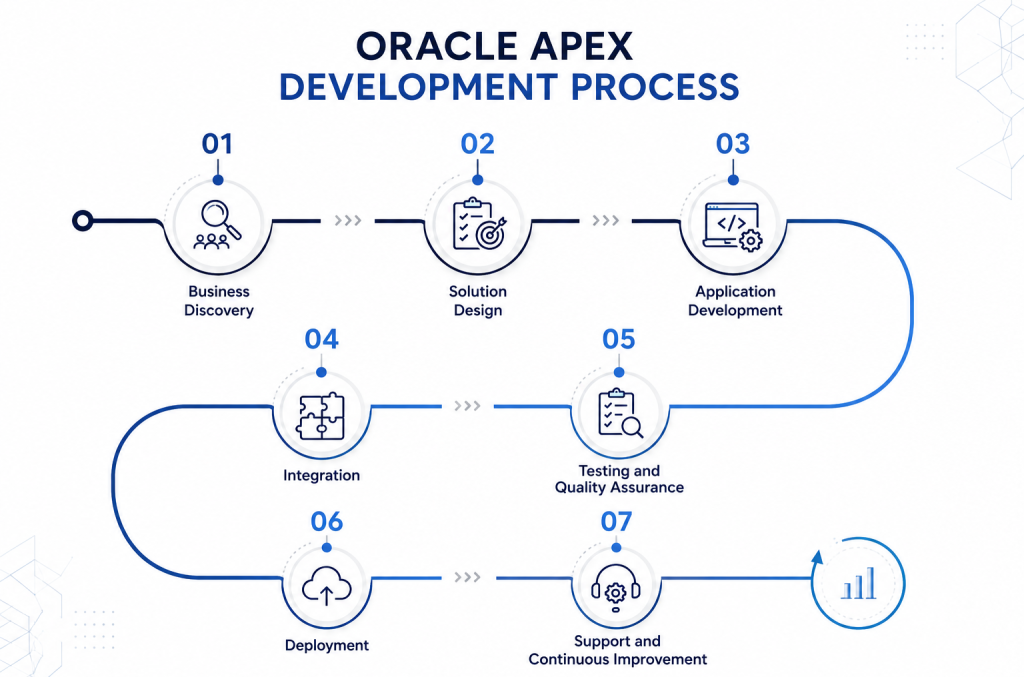
A typical Oracle APEX development lifecycle includes the following stages:
1. Business Discovery
The project begins with understanding business challenges, existing workflows, user requirements, and integration needs. Stakeholder workshops help define clear project objectives.
2. Solution Design
Based on business requirements, architects design the application structure, database model, user experience, security model, and integration approach.
3. Application Development
Developers build the application using Oracle APEX, creating forms, reports, dashboards, workflows, validations, and business logic.
4. Integration
The application is integrated with Oracle ERP, Oracle HCM, Oracle Fusion Applications, Oracle Integration Cloud, REST APIs, and other enterprise systems where required.
5. Testing and Quality Assurance
Functional testing, performance testing, security validation, and user acceptance testing ensure the application meets business expectations before deployment.
6. Deployment
Applications are deployed to development, testing, and production environments following established governance and change management processes.
7. Support and Continuous Improvement
After deployment, organizations continue enhancing applications based on user feedback, evolving business requirements, and Oracle platform updates.
Real-World Business Use Cases
Oracle APEX Development Services enable organizations to build applications tailored to specific business functions, improving efficiency without replacing core enterprise systems.
| Business Challenge | Oracle APEX Solution | Business Outcome |
|---|---|---|
| Employee onboarding delays | Employee Self-Service Portal | Faster onboarding and improved employee experience |
| Manual vendor management | Vendor Portal | Streamlined supplier collaboration |
| Approval bottlenecks | Automated Approval Workflow | Reduced processing time and greater transparency |
| Lack of operational visibility | Executive Dashboard | Real-time reporting and informed decision-making |
| Legacy Oracle Forms applications | Application Modernization | Improved usability while preserving business logic |
| Asset tracking challenges | Asset Management System | Better visibility into organizational assets |
| Customer service inefficiencies | Customer Portal | Enhanced customer engagement and self-service |
| Compliance tracking | Compliance Management Application | Improved audit readiness and regulatory compliance |
These use cases demonstrate how Oracle APEX can address department-specific requirements while supporting enterprise-wide digital transformation initiatives.
Industries Using Oracle APEX Development Services
Organizations across industries use Oracle APEX Development Services to build secure, scalable, and business-specific applications. Because Oracle APEX is database-centric and highly customizable, it supports diverse use cases ranging from internal workflow automation to customer-facing portals.
While the platform is industry-agnostic, businesses that already use Oracle technologies often realize faster implementation and greater integration benefits.
| Industry | Common Oracle APEX Applications | Business Value |
|---|---|---|
| Manufacturing | Production Monitoring, Quality Inspection, Inventory Management | Improved operational efficiency and real-time visibility |
| Healthcare | Patient Administration, Staff Management, Compliance Tracking | Better regulatory compliance and streamlined operations |
| Retail & E-commerce | Vendor Portals, Store Operations Dashboards, Loyalty Management | Enhanced supplier collaboration and business insights |
| Financial Services | Approval Workflows, Audit Management, Risk Reporting | Increased governance and faster decision-making |
| Education | Student Information Systems, Faculty Portals, Admission Workflows | Simplified academic administration |
| Logistics & Supply Chain | Fleet Tracking, Warehouse Management, Delivery Monitoring | Improved operational visibility |
| Government & Public Sector | Citizen Service Portals, Document Management, Compliance Applications | Digital public services with secure access |
| Human Resources | Employee Self-Service, Leave Management, Performance Tracking | Better employee experience and HR efficiency |
The flexibility of Oracle APEX allows organizations to start with a single application and gradually expand into a comprehensive portfolio of enterprise solutions.
Best Practices for Successful Oracle APEX Projects
Successful Oracle APEX implementations are driven by strong planning, scalable architecture, secure development practices, and continuous collaboration between business stakeholders and technical teams.
Developing an enterprise application involves more than selecting the right technology. Following proven practices ensures that applications remain reliable, secure, and easy to maintain as business requirements evolve.
1. Define Clear Business Objectives
Start with the business problem rather than the technology. Establish measurable goals such as reducing approval time, improving reporting accuracy, or automating manual processes.
2. Design for Scalability
Applications should support future business growth. A modular architecture makes it easier to add new features without extensive redevelopment.
3. Prioritize User Experience
A simple, intuitive interface improves adoption and reduces training requirements. Focus on minimizing clicks, simplifying navigation, and providing responsive layouts for mobile users.
4. Build Security into the Design
Implement role-based access control, secure authentication, session management, and data validation from the beginning rather than treating security as an afterthought.
5. Leverage Standard Oracle Capabilities
Use Oracle APEX’s built-in components wherever possible instead of developing custom functionality that increases maintenance complexity.
6. Optimize Database Performance
Efficient SQL queries, proper indexing, and optimized data models help applications perform well even as transaction volumes increase.
7. Plan Integrations Carefully
Define integration requirements early, especially when connecting with Oracle ERP, Oracle HCM, Oracle Fusion Applications, Oracle Integration Cloud, or external REST APIs.
8. Test with Business Users
User Acceptance Testing (UAT) should involve actual end users to validate workflows and identify usability improvements before deployment.
Why Choose Kovaion for Oracle APEX Development Services?
Selecting the right implementation partner is as important as choosing the right technology. Organizations should look for a partner with deep Oracle expertise, proven enterprise experience, strong integration capabilities, and a focus on long-term business value.
At Kovaion, our approach to Oracle APEX development emphasizes building applications that align with business goals while integrating seamlessly into the broader Oracle ecosystem.
Our strengths include:
- Oracle Expertise: Experience across Oracle technologies, including Oracle APEX, Oracle Database, Oracle Cloud, Oracle Fusion Applications, and Oracle Integration Cloud.
- Enterprise Implementation Experience: A structured delivery approach designed for complex business environments and enterprise-scale projects.
- Integration Capabilities: Expertise in connecting Oracle APEX applications with ERP, HCM, CRM, and third-party systems using REST APIs and Oracle integration technologies.
- Security-First Development: Applications are designed with role-based access controls, secure authentication, and governance best practices.
- Scalable Architecture: Solutions are built to accommodate future business growth, new integrations, and evolving operational requirements.
- Collaborative Delivery: We work closely with business stakeholders throughout the project lifecycle to ensure solutions meet functional and technical expectations.
Rather than delivering one-size-fits-all applications, the focus is on developing Oracle APEX solutions that address specific business needs while supporting long-term digital transformation initiatives.
Conclusion
Oracle APEX Development Services provide organizations with a practical way to build, modernize, and extend enterprise applications without the complexity of traditional software development. From workflow automation and reporting dashboards to Oracle ERP extensions and legacy application modernization, Oracle APEX enables businesses to deliver secure, scalable, and user-friendly solutions faster.
However, the success of an Oracle APEX initiative depends on more than the platform itself. Clear business objectives, a structured implementation approach, strong governance, and experienced technical guidance all play a critical role in achieving measurable outcomes.
For organizations looking to accelerate digital transformation while maximizing their Oracle investments, Oracle APEX offers a flexible and future-ready foundation for enterprise application development.
Ready to Modernize Your Enterprise Applications?
Whether you’re planning to build a new business application, modernize legacy Oracle Forms, extend Oracle ERP or HCM, or automate complex business workflows, Oracle APEX Development Services can help you achieve these goals efficiently.
Looking to explore what’s possible with Oracle APEX? Connect with the experts at Kovaion to discuss your application requirements and discover how enterprise-grade Oracle APEX solutions can support your digital transformation journey.
Frequently asked Questions
-
Oracle APEX Development Services cover the complete lifecycle of building enterprise applications using Oracle APEX, including business analysis, solution design, application development, database design, integrations, testing, deployment, modernization, and ongoing support. They help organizations build secure and scalable applications while leveraging their existing Oracle investments.
+ -
Businesses can benefit from Oracle APEX Development Services when they need to automate manual workflows, modernize legacy Oracle Forms applications, connect disconnected systems, improve reporting and data visibility, or extend Oracle ERP, Oracle HCM, or Oracle Fusion Applications.
+ -
Oracle APEX can be used to build a wide range of enterprise applications, including employee self-service portals, approval workflows, vendor portals, expense and budget applications, asset management systems, customer portals, compliance applications, help desks, KPI dashboards, and Oracle ERP or HCM extensions.
+ -
Key benefits include faster application development, lower development and maintenance costs, workflow automation, improved productivity, enterprise-grade security, scalability, mobile accessibility, seamless integration with Oracle and third-party systems, and real-time reporting.
+ -
Yes. Oracle APEX applications can integrate with Oracle ERP, Oracle HCM, Oracle Fusion Applications, Oracle Integration Cloud, Oracle Database, REST APIs, and other third-party systems. These integrations enable organizations to extend existing enterprise platforms without necessarily replacing their core systems.
+ -
Businesses should evaluate a partner based on Oracle expertise, enterprise implementation experience, integration capabilities, security practices, scalable architecture, and long-term application support. A strong partner should also understand business requirements and collaborate with stakeholders throughout the application lifecycle.
+